

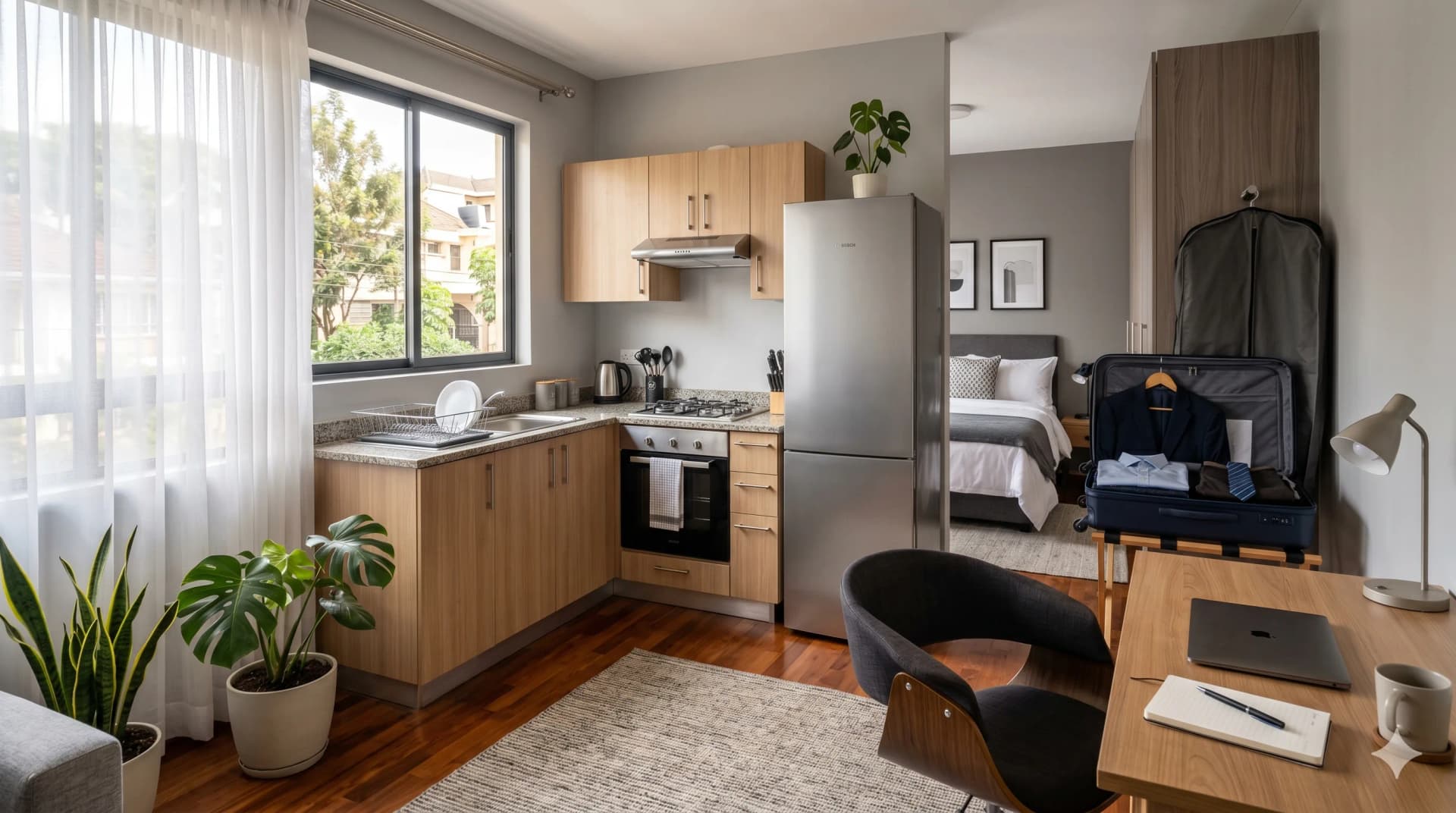
Why Hotels Stop Making Sense After a Week
The international hotels that UN and NGO travellers typically book in Nairobi — properties in Westlands, Kilimani, and Upperhill — run USD 150–300 per night for a standard room. For a two-week assignment, that is USD 2,100–4,200 in accommodation alone. Most per diems for Nairobi from UN agencies and large bilateral organisations are calibrated to cover both accommodation and meals combined. At USD 150–200 per night on a room, there is not much left for food.
A furnished two-bedroom apartment in Kilimani or Westlands — proper kitchen, separate living space, in-unit laundry — runs KES 9,000–18,000 per night on a two-week booking, or roughly USD 70–140. At a month, the per-night equivalent drops a further 20–30%. The break-even against a hotel is around night five.
Hotels earn that rate. The full-service model bundles real things: housekeeping, concierge, F&B, 24-hour reception, engineering on call. For delegations, first-time Nairobi visitors, or anything under five nights, those services are worth what you pay. What changes at two weeks is the ratio of what you are paying for against what you are actually using — the restaurant you have stopped eating at, the concierge you have not called, the daily housekeeping that interrupts your morning call. At fourteen nights, the product no longer fits how you are living in it.
What to Look For
Not every furnished apartment in Nairobi is the same product. These are the five things that determine whether a property works for a longer working stay.
Internet connection: The honest question is not “do you have Wi-Fi” — every operator claims fast internet. Ask for the ISP and the plan. In Kilimani and Westlands, Safaricom Home Fibre is the most consistent provider for dedicated residential connections, with 100 Mbps plans widely available. The issue with shared connections — whether in an apartment building or a hotel — is contention: ten residents on video calls at 9am on the same link. Ask whether the apartment has a dedicated fibre connection to the unit. A managed property should be able to answer this clearly; if they cannot, assume it is shared.
Generator coverage: Kenya Power (KPLC) publishes scheduled outages through their X account (@KenyaPower_Care) and customer portal — you can check upcoming outages for a specific area before you travel. Unscheduled outages are less common than they were a few years ago but still happen. A building with a standby generator restores in under 30 seconds. A building without one leaves you without power and Wi-Fi until the grid recovers. For anyone working across the EAT–Europe time overlap — where 8pm Nairobi is the London close — this is not a minor inconvenience. Ask specifically whether the building has a generator and whether it covers the apartments or only common areas.
Self check-in: Most guests arriving in Nairobi come through JKIA. Late arrivals are routine — long-haul connections from London, Amsterdam, Dubai, and Guangzhou frequently run past midnight. Properties with keypad or app-based entry handle this without any coordination. We built our units this way because guests checking in after midnight are not unusual; they are a normal part of the job. Having someone on call at 1am is not a sustainable model. Having a door that works at 1am is.
Laundry: In-unit washing machine for stays of a week or more. Building laundry services vary in reliability. Confirm this before booking if your assignment is ten days or longer.
Kitchen specification: Some furnished apartments have a kitchen surface and a kettle. Others have a working kitchen — hob, oven or microwave, full fridge, utensils. Ask for photos of the kitchen specifically, not just the living area. The difference shows up in your food budget within the first three days.
Which Neighbourhood for Your Assignment
The neighbourhood decision for most expats comes down to where they are working.
UN staff at Gigiri (UNON): Westlands is the standard recommendation — approximately 12–13 km from the Gigiri complex via Limuru Road, 20–30 minutes off-peak. The neighbourhood has housed UN staff and contractors for decades and most UN housing guidance points here first. Our Westlands apartments at GTC on Westlands Road, Marina Bay Square on Sports Road, and Sunstone on General Mathenge Drive cover different parts of the neighbourhood: GTC in the commercial heart, Marina Bay and Sunstone on quieter residential streets.
NGO and development sector staff in Upper Hill: Kilimani is better positioned. Upper Hill is directly east of Kilimani — several bilateral development agencies and a significant share of international NGO offices are based there. The commute from Kilimani is 10–15 minutes off-peak, versus the longer run through the CBD corridor from Westlands. Kilimani also gives you Nairobi Hospital immediately accessible on Argwings Kodhek Road, which matters for staff who may need to access occupational health or specialist services during a longer assignment.
Digital nomads on the Class N visa: Kenya's digital nomad visa — valid for one to two years for earners above USD 55,000 annually — launched in May 2025 and created a distinct accommodation profile: stays of one to six months by independent professionals who are not tied to a specific office. For this group, Kilimani and Westlands are both well-suited. Kilimani tends toward quieter, larger apartments with more space for a proper home office setup. Westlands puts you close to the co-working ecosystem — Nairobi Garage and iHub are both in the neighbourhood. The Nairobi Expressway connects Westlands to JKIA in 15–25 minutes, which matters if you are flying in and out regularly.
Assignments without a fixed office: Kilimani is the most consistent recommendation — larger apartments, better value, quieter, and well-positioned for the Expressway if you need to move around the city. Kileleshwa is a quieter alternative in the same corridor if you want residential calm without the Westlands nightlife footprint.
Rates and What They Include
A working baseline for furnished apartments in Kilimani and Westlands in 2026:
Studios from KES 3,400–5,500 per night. One-bedroom units from KES 7,500–17,500. Two-bedrooms — the most common choice for expats who want a desk separate from the bedroom — from KES 9,000–22,000 depending on building, floor, and specification. GTC Westlands sits at the higher end of that range; Kilimani residential apartments at the lower end.
Those figures should include Wi-Fi, electricity, water, and in most cases access to building amenities — pool, gym, parking. Monthly rates for 30-day bookings are typically 20–30% below the equivalent nightly rate. If your organisation is booking on a per diem, confirm whether your length of stay qualifies for the monthly rate before committing to a nightly booking.
Payment and invoicing: Direct bookings can be paid by M-Pesa or card (Visa, Mastercard). If your organisation requires formal invoicing for expense reimbursement, confirm the operator can issue a tax invoice in the name of a Kenya-registered entity. Platforms that intermediate the booking — Airbnb, Booking.com — typically issue receipts in the platform's name rather than the operator's, which creates complications for finance teams that need a local vendor on the expense claim. Booking direct resolves this.
The Neighbourhood Guides
The individual guides go into more depth on each area — what to eat, where to shop, hospital access, getting around: